
When a person is missing and foul play is suspected, finding a body is a priority, and forensic anthropologists can help
Katie East
In June of 2020, a team of investigators carefully searched the property of Chad Daybell and Lori Vallow in Salem, Idaho. The couple were under investigation following the disappearance of two children in their care. While scouring the backyard, officers noticed an innocuous four-by-two-foot patch of short grass that stood out against the backdrop of taller weeds. Below that patch of grass investigators found the remains of a young boy. The body was later identified as J.J. Vallow.
This discovery is an example of how the principles of forensic anthropology and forensic taphonomy can be used to locate human remains, even if they are hidden. Forensic anthropology is the study of human remains, while forensic taphonomy is the study of what happens to human remains after death. In addition to understanding the human body and how it decomposes, investigators must rely on their senses of smell, feel, and sight.
Smell

For years in the late 2000s, a rancid smell hung around the house of Anthony Sowell in Cleveland, Ohio. Although several women had disappeared in the neighborhood, investigators and neighbors assumed the smell originated from a nearby sausage factory. It was only after a victim escaped that investigators realized the smell came from the 11 decomposing bodies found inside the home.
Decomposing human bodies have a particular aroma; it is a bit like rotting meat and fruit. The smell comes from biological and chemical reactions, insects, and bacteria that release volatile organic compounds. Investigators can sometimes follow their nose to a corpse, but other techniques are required once decomposition is complete or the body is buried.
One common method of detecting human remains when they are not smelly enough for human noses is to use dogs. Dogs’ noses are 10,000–100,000 times stronger than those of humans. Dogs can also be trained to locate targets and alert when they do. Dogs have a reported success rate of 83%–100%. However, not all cadaver dogs are created equal. There are no universal standards for the training or certification of dogs or to measure the skill of the handler. One researcher summed up the use of cadaver dogs: “Their ability to detect [buried human remains], while poorly understood, uncharacterized, and unstandardized, is nevertheless impressive.”
Multiple researchers are working on creating machines or applying existing technologies to identify odors from decomposing human remains. Although promising, until they are perfected, dogs remain the preferred method of detection.
Feel

During the search of the Branch Davidian compound at Mount Carmel, Texas, investigators were directed to the basement, where bodies were said to have been buried. The area was 30 by 100 feet with a dirt floor. Investigators dug all day, and cadaver dogs were brought in without success. It wasn’t until investigators employed their sense of touch, through the use of soil probes, that they identified an area of disturbed soil in the northwest corner, where four bodies were ultimately uncovered.
Soil is mixed and aerated during the digging of a grave. Investigators can use a probe to differentiate between stable, compact soil and the disturbed soil of a grave. Soil probes are long sharp tools that will pass through the disturbed soil more easily. Investigators carry out a systematic survey of the area in this fashion, inserting the probe at regular intervals and consistent depths.
Touch can also identify differences in temperature consistent with a decomposing body. In the early stages of decomposition, a human body will cool down, eventually matching the surrounding temperature. However, in the later stages of decomposition, a body can actually heat up. Bacterial activity can warm a body up to 50°F higher than the surrounding environment. Blowfly larva, or maggots, can also generate heat. Maggots feed in groups, known as maggot masses, and can generate and insulate heat that may produce temperatures as high as 122°F. The heat generated by a body may be felt in the soil surrounding the body. However, new advancements use thermal infrared cameras, sometimes mounted on airplanes, to detect the heat of decomposing human remains.
Sight

In the summer of 2002, investigators searched 30 acres of the Pickton Farm for the remains of up to 69 women. They carried out a pedestrian search, excavated large sections, and sifted over 300,000 hundreds of cubic yards of soil to find any traces of human remains. Because the remains were likely dismembered, left to decay, or consumed by animals, all that was found were small fragments of bone. They collected 600,000 pieces of evidence and 200,000 DNA samples leading to the identification of several victims. Robert Pickton was convicted on six counts of murder.
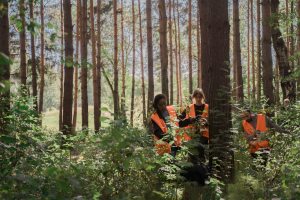
One of the most effective ways of finding hidden bodies is a pedestrian survey, a fancy way of saying a walking search. Teams walk across suspected areas in a careful and controlled pattern, keeping their eyes glued to the ground. They are searching for evidence or pieces of bone as well as changes to the landscape.
The act of digging a grave, and the fluids of an actively decomposing body, can kill surrounding vegetation. At the same time, the loosened soil will not fit back into the grave. As decomposition progresses, however, new nutrients are introduced into the soil and the mixing of the soil may bring new seeds. A pile of bare soil also provides a clean slate for new species of vegetation. Consequently, the vegetation above a body may be different or lusher than surrounding areas. As the soil settles and the body decomposes, the grave may become depressed from its surroundings.
An investigator’s sense of sight can be enhanced using remote sensing technologies such as ground-penetrating radar or magnetometry. These technologies can reveal anomalies below the surface that differ in density or magnetic composition from surrounding soil. However, they do not work well in all soil types, and the devices will pick up any anomaly, which must then be interpreted by an analyst.
TL; DR
Despite how TV and pop songs might make it seem, successfully hiding a body is challenging. Anthropologists have an in-depth understanding of decomposition and can use smell, touch, and sight to locate hidden human remains. As technology improves, hidden graves will continue to get easier to find, helping to bring justice to more victims.
For shows on forensic anthropology, check out Skeleton Stories, Secrets of the Morgue, and The New Detectives.
About the Author
Katie East has been a professional forensic anthropologist since 2018 and received her PhD in 2021. By day, she analyzes skeletons, and by night (and weekends), she educates public audiences. With over a decade working in museums, laboratories, and field settings, Katie offers a broad range of insights about forensic anthropology to audiences from diverse backgrounds. In light of the widespread popularity of forensic anthropology, she believes that forensic anthropologists need to do a better job of educating the public about what they do and how they do it.

 True Crime Docket